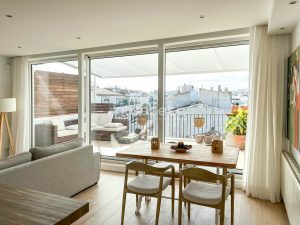
Choosing windows is not just about aluminium or PVC.
The glass is the most important part of the assembly because it usually occupies most of the window's surface: in modern windows, it is common for the glazing to represent approx.
between 70% and 85% of the area, and in some designs with finer profiles it can be even more.
That's why, if you get the glass right, you notice it every day: more stable temperature, less noise, more security and less condensation.
Camera glass: the foundation for insulation (double glazing)
When we talk about camera glass (also called double glazing), we refer to two glasses separated by a sealed chamber (air or gas). This is the “base” configuration to start getting good insulation.
Common confusion: “Climalit” is not a type of glass, it's a popular way of calling it.
It is very common to use “Climalit” as if it were a specific glass, when in practice it is usually used as a synonym for double glazing / camera glass.
Said simply:
• Camera glass = the format (two glasses + one chamber)
• And within that format you choose what glasses you mount: low emissive, solar control, acoustic, safety laminate, etc.
Key idea: “Climalit” is fine as a starting point, but to get it really right you need to define what you need (thermal comfort, solar control, silence, security…).
GLASS SPACER (SEPARATOR): THE SMALL DETAIL THAT MAKES A BIG DIFFERENCE
Between the two glasses of double glazing there is a separator (also called intercalary
or spacer), which maintains the distance and seals the chamber. This detail is more important than it might seem.
• Traditionally, the usual was a aluminium separator (metal).
• Today, in higher-performance windows, the “warm edge” (warm edge) is increasingly used: hybrid/synthetic separators with lower thermal conductivity.
What do you gain with a warm edge?
• Less “cold edge” around the perimeter of the glass.
• Less risk of condensation around the frame.
• Better overall thermal performance.
Put simply: the warm edge helps prevent the glass from “cooling” so much at the edges, and that translates to more comfort and less humidity at the edge, especially in winter.
- Traditionally, the usual was an aluminium separator (metal).
- Today, in higher-performance windows, the "warm edge" (warm edge) is increasingly used: hybrid/synthetic separators with lower thermal conductivity.
What do you gain with a warm edge?
- Less "cold edge" around the perimeter of the glass.
- Less risk of condensation around the frame.
- Better overall thermal performance.
LOW-EMISSIVITY GLASS: THE MOST PROFITABLE INVESTMENT IN COMFORT
Low-emissivity is an almost invisible treatment that helps retain interior heat in winter and improves efficiency.
When the investment is worth it:
• If you are looking for comfort and savings without complications.
• If you are bothered by the “cold” that you feel near the glass in winter.
• If you want the temperature to be more uniform throughout the room.
It is an improvement that you cannot see, but you notice it right away: you will feel like being near the window without feeling that typical “coolness”.
- If you are looking for comfort and savings without complications.
- If you are bothered by the "cold" that you feel near the glass in winter.
- If you want the temperature to be more uniform throughout the room.
It is an improvement that you cannot see, but you notice it right away: you will feel like being near the window without feeling that typical “coolness”.
SOLAR CONTROL GLASS: TO AVOID "A ROOM WITH A VIEW OF AN OVEN"
Solar control glass reduces the solar energy that enters. It is especially useful in orientations with a lot of sun (south/west) or large windows.
When the investment is worth it:
• If in summer the living room overheats even though you ventilate.
• If you have direct sun for many hours.
• If you want to depend less on air conditioning.
Can a greenish hue be seen? Yes, sometimes.
In some solar control glasses, depending on the light and angle, a slightly greenish tint can be appreciated (for example, in Guardian Sun type configurations).
Two important ideas:
1. In everyday life it is normally not something that “stands out”. To really notice it, many times you have to look quite hard or compare it side by side with a completely neutral glass.
2. If for you it is very important to avoid any tonality, you can request an extra clear camera glass, like Guardian ExtraClear, which is designed for a more neutral aesthetic (more “clean crystal”).
In a camera glass you have two panes: one facing outward (street/sun) and the other facing inward (your home), and in the following section we explain where each type of glass goes, on the inside or on the outside.
When does the investment pay off:
- If the living room overheats in summer even with ventilation.
- If you have direct sunlight for many hours.
- If you want to depend less on air conditioning.
Can a greenish hue be seen? Yes, sometimes.
In some solar control glasses, depending on the light and angle, a slightly greenish tint can be appreciated (for example, in Guardian Sun type configurations).
Two important ideas:
- In everyday life it is normally not something that “stands out”. To really notice it, many times you have to look quite hard or compare it side by side with a completely neutral glass.
In a camera glass you have two panes: one facing outward (street/sun) and the other facing inward (your home), and in the following section we explain where each type of glass goes, on the inside or on the outside.
WHICH GLASS GOES WHERE?
Which glass is placed in each treatment within a double glazing?
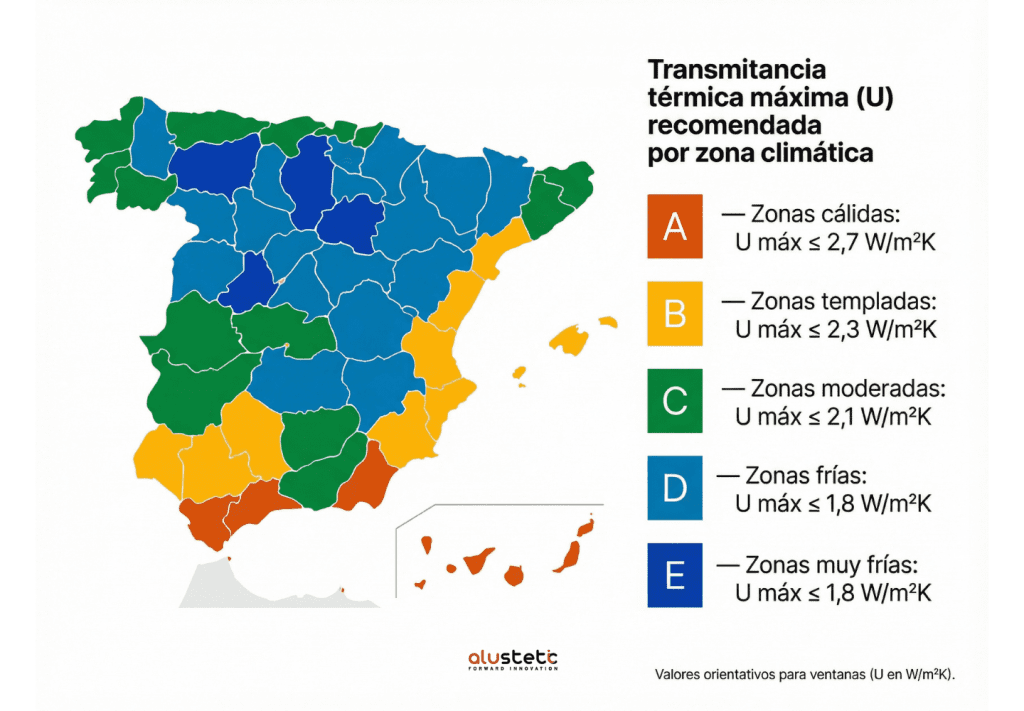
- Solar control: is usually placed on the outer glass, because its job is to block part of the sun's energy before it enters the room.
- Low-emissivity: is usually placed on the inner glass, to reduce heat loss and improve comfort in winter.
- Acoustic (acoustic laminate): can be placed on the outer glass, on the inner glass or even on both, depending on the noise level and the objective. In most cases, it is designed so that the set has:
- asymmetry (different thicknesses between the inner and outer glass), and
- an acoustic laminate sheet where it is most convenient.
The important thing: it's not about “choosing the most expensive glass”, but about configuring the double glazing system logically based on sun, noise, safety, and the type of window.
ARGON GAS: THE THERMAL PLUS THAT ROUNDS OUT THE WHOLE PACKAGE
Argon is introduced into the chamber instead of air to improve thermal insulation.
When the investment is worth it:
- Si ya eliges un vidrio con bajo emisivo y quieres mejorar rendimiento.
- If you care about thermal comfort and want to go one step further without changing the appearance.
ACOUSTIC GLASS: WHEN YOU REALLY WANT TRUE SILENCE
If noise really bothers you, the most important thing is to understand this:
Double glazing alone is not enough.
- Suitable thicknesses
- Acoustic laminate
- Window airtightness
- A well-sealed installation
In addition, in a camera glass the acoustic laminate can go in one of the two sheets (or both). The most common approach is to combine one laminated sheet with another of different thickness to improve the result.
3+3 vs 4+4: Why do we recommend a minimum of 4+4?
When we talk about 3+3 or 4+4, we're talking about laminated glasses:
- 3+3 = two 3 mm glasses laminated together
- 4+4 = two 4 mm glasses laminated together
Here's the key:
- 4+4.2 means: two 4 mm panes of glass + two intermediate layers (instead of a standard one).
- That “.2” refers to the inner laminations, which are the ones that provide:
- more safety (better performance against impact and breakage)
- and, if they have acoustic treatment, also better sound insulation
In summary
The inner sheet is the heart of the laminate: the more suitable it is, the more protection and more noise control.
SAFETY GLASS: PEACE OF MIND IN GROUND FLOORS AND EXPOSED AREAS
Safety glass is usually laminated because if it breaks, it stays adhered and doesn't fall in dangerous fragments.
When the investment is worth it:
- Ground floors or easy access from the street.
- Large windows or areas of passage.
- Homes with children or elderly people (safety against breakage).
And here's the important piece of information again:
- A 4+4.2 laminate usually offers more safety than a more basic laminate, due to the composition of its intermediate layers.
DOUBLE VS TRIPLE GLAZING: WHEN THE INVESTMENT IS WORTHWHILE
Triple glazing (three panes and two chambers) can improve thermal insulation, but it's not always the most logical option. In coastal areas like Garraf, often a well-configured double glazing already offers excellent comfort. For reference, in Spain there is the Building Technical Code, which establishes minimum efficiency requirements (by climate zones) and helps understand when it makes sense to go “one step further”. We explain it in a simple way in the next section, so you can locate your case.
When is triple glass usually worth the investment
It usually makes sense if any of these situations apply:
- You live in a clearly colder area (inland, high altitude, harsh winters) and you are looking for maximum thermal insulation.
- Your house is already generally well insulated and you want to take comfort to the limit (less cold surface, more stable temperature).
- You have large glazed surfaces and want to maximize efficiency (always evaluating it with the window as a whole).
WHAT THE BUILDING TECHNICAL CODE REQUIRES WHEN CHANGING WINDOWS (CTE)
When you change windows, the Building Technical Code evaluates the complete window assembly, not just the glass:
- Window (marco + vidrio)
- And if exists, shutter box
- Instalación
And this is key to understanding why a “very good” window can disappoint if the overall assembly is not well designed.
Examples of common climate zones in our area
In our area (Garraf, Barcelona and Costa Tarragona), the typical situation is to fall between these climate zones of the CTE:
- Vilanova i la Geltrú → C2
- Sitges → C2
- Vilafranca del Penedès → C2
- Calafell → B3
- Castelldefels → C2
- Barcelona → C2
- El Vendrell → B3
Quick translation: Garraf and Barcelona tend towards C2. Moving down towards Baix Penedès (Calafell / Vendrell) zone B3 appears.
What does "U maximum" mean and why should you care?
U (or thermal transmittance) is a way to measure how much heat “escapes” through an element.
- The lower the U, the better it insulates.
- When the Building Technical Code defines a U maximum, it is establishing a minimum efficiency standard.
In the CTE, the limit used when talking about windows is the U of the complete window assembly (UH), that is:
- glass + frame + (if exists) shutter box
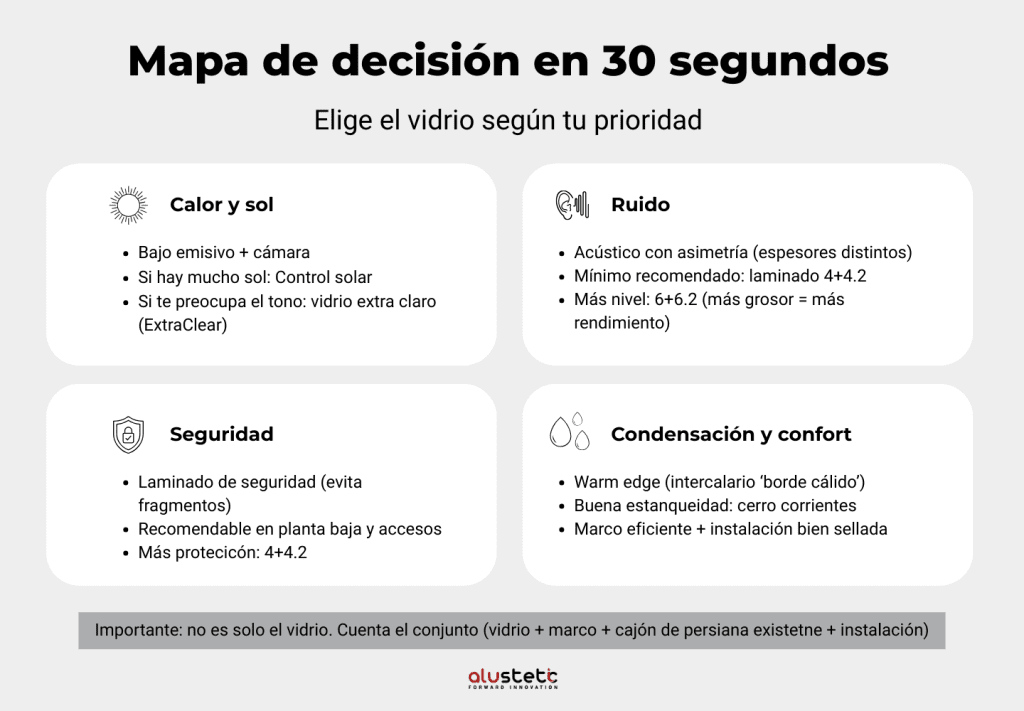
Typical limit guidelines (CTE DB-HE1):
- Zone C (as C2) → UH ≤ 2.1 W/m²·K
- Zona B (as B3) → UH ≤ 2,3 W/m²·K
Below you can see the map of Spain with the different climate zones according to the CTE, which are classified from zone A (warmest) to zone E (coldest).
Choosing the right glass is not about “putting the most expensive one”, but about finding the right configuration that fits your home: orientation, sun, noise, humidity, security… and, above all, ensuring the entire assembly (glass + frame + shutter box if it exists + installation) is well resolved. If you like, we make it easy for you: tell us where you are, if you have blinds, what concerns you most (heat, cold, noise, condensation or security) and the approximate size of your windows. With that information we recommend you a logical and balanced solution, so you notice the investment day by day.